Thursday, June 25, 2015

Summer Learning

In the summertime when Arizona weather is so hot we stay inside. We take mini vacations, work on projects, take care of animals and the garden and focus on the joy of learning. It isn't so much a lesson plan or recipe book of activities we use as we just following our families life's interest.
We began June with a short trip to Colorado. a 14 hour trip by car from our home to my old home in the northwest corner of that state. The journey takes us through the desert biomes of Arizona's Sonoran Desert on to Monument Valley in the Navajo Nation, to the Utah Canyon Lands and up into the western high Rockies mountain biomes.  We drive it in one day and it is an adventure. Here are some photos .

The Navajo Nation is a wide open desert with these iconic southwestern images of rocks that rise like cathedrals out of the flat desert landscape. We talk about how wind and sand form this place and how they people have lived and adopted to life here in Monument Valley. Last summer we drove over a different route of reservation area coming down from Cortez, CO in to Farmington, New Mexico and down to what is left of Route 66. This gave my son more scope to the width and diversity of this large area of these reservations in the Four Corner Area.
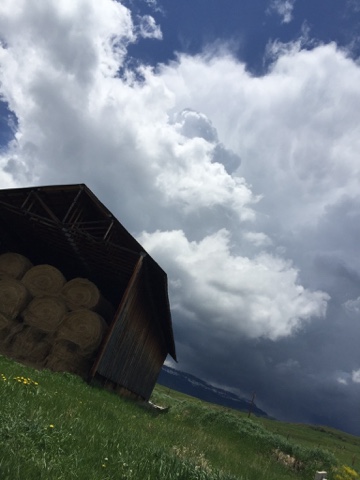
We got to our friend's house who lives at about 8000 feet above sea level on a beautiful ranch in the high mountains. Here is a hay barn where a Mamma fox had her pups or kits.  We tried to get photos of them but we were too loud and they ran away.  Still what a great place to raise a littler of babies. There were many different kinds of rodents too. Whistle pigs that look a bit like ground hogs had tunnels all over the ground and smaller ground squirrels and mice. The high passes surrounding us still had deep snow on them so summer was just beginning and the world was ten million different shades of green.
There were two Bulls in this pasture. They have been turn out with all the young females.  This is called rutting season. The bulls can be unpredictable and we left them alone.  In the morning the females would come up to the house and stand in the morning shade of the trees that surround the house that were planted so long ago by a rancher in the 1800's.  They are the only shade for them and they enjoy the mornings long shadows of the trees into their field. They wander away at around 10:00 AM.  Sometimes they moo at us as if to ask for oats or a treat but they have a whole valley of green to eat.
Here is a picture of the big trees planted so long ago. They are Cottonwood trees.

We also learned about sustainability housing by visiting an old friend of mind who has been designing, building and creating his own green home. Our friend Lock used straw bales and steel frame structure, facing south and using convection heating methods in the lower floor. It is a massive structure and the hay bales were not hobbed over yet but even as it is, he lived in it this year and it is coming right along.  Lock also designed a wonderful spiral staircase with a supporting sixteen sided pillar out of wood with no nails. It wasn't done yet as it had no hand rail.  We were all very impressed with our friend's ideas and work.  Conor loves Lock's designing skills.
Conor was very impressed that Lock had two TV's over his bed. These two creative builders has much in common.  Lock gave us a tour and we were off to see more.

We only had a week with friends in Colorado and it was back to Arizona. This was the sun's rays coming up over the ranch house.
We drove all the way back in one day.  I don't know why I do that?
Since we have been working on learning about astrobiology and using the ASU MARS ED NASA Curriculum I have blogged about in the past, we have been thinking about creating a colony on Mars and building a model.  Conor and his friend Ben have been using a geology map, I have from a Mars Ed ASU teacher's conference, as a mat surface to build sub stations and green houses.  They have created vehicles for Mars mission.  Also robotic helpers and a mining operation all out of Legos and Zometools.  They also made a polar sub-station to collect water and refining the atmospheric methane and oxygen with H20 to make jet fuel for the ride home.  We have talked about all kinds of possibilities of living on Mars.  I collected resources and made a Pinterest Board called Mars Ed HERE .   One of my friend's son has also joined us on our mission making his own station for colony to sleep in and eat.  His bunker substation can be found on the Pinterest Mars Ed page.
I was speaking about our porject with our Educator/Mentor Michael Bender, who is with SelfDesign Global (you can find out about that HERE) and he suggested using that group's Minecraft Server to create a Mars Colony out of a desert Biome.  I shared my Pinterest Board with him and his wife, Lori who lead a Self Designer group of Minecrafters and Michael has created a red sand and sandstone biome and the students have now created a building code. So big things are happening with learners in this group on the server.  Conor has survived a few days and nights on Minecraft Mars.   He made a first shelter, planted a garden, started tunneling and found an abandoned mine and water. His group decided on glass domed habitats and air locking doors.  Minecraft survival biomes, like our Mars are teaming with the un dead after dark.  There are Zombies and skeletons spawing in the mine. Who knew about all this undead life on Mars?  We have a rocketship around the portal so there is the idea of what you bring with you and what you can use while there and how much would it cost to go back to EARTH for a bucket of water in real life?  I'll keep updating on this project.  My son is aslo wanting to create MC biome models of the moons of Io, Europa and Titan too.  You can see the Pinterest resources board for that HERE.
Here is a little Zombie looking in at us from the outside of the glassed in habitat.


Sunday, May 3, 2015

Dream Catchers and Learning Through Crafting

This is another example of how to use a manipulative and the building of one to teach a lesson in geometry.  Making dream catchers and origami teaches us order and sequencing.  We learn patience and discipline.  We learn how to correct our mistakes, go back and fix things.  Beyond learning to how to self correct we learn about making and the effort involved in seeing a project created by our hands.  Beside the obvious lesson of building a project and gaining mastery of skills using our eyes and hands, we learn precision and discipline are valuable tools to us in completing projects.
 Steps matter, order matters, doing a thing right matters and also mistakes can lead to beautiful things too.
Dream Catchers are easy and simple to make. Any polygon will do but circles are the traditional shape. The hoop and  circle shape is an archetype and this had meaning to the first people, the native people, the creators of he dream catcher.  You can make your own ring out of a willow branch or some bendable object of your choosing.  You can choose to cover the hoop or ring with yarn or leather strips, sinew or string or nothing.   I am using a embroidery hoop that is larger to show  in this tutorial but you can use key chain rings or heart shaped objects and any polygon.  Any shape that connects to it's self.  I have used old bracelets and earring hoops. It can be fun to search in your home for the ring or hoop so be creative. This is one made out an old bracelet.

I like to tell the stories and share the history of the Dream Catcher's.  The internet is filled with variations to the lore.  I also recommend looking at spider webs before and after this process and pointing out to learners the sacred geometry in nature and how these designs in geometry are the building blocks and keys to so much around us.  This is a great sight for the lore on Dream Catchers. HERE


Need List
Hoop
Any choice of string, yarn, embroidery thread, leather, sinew or cording.
Scissors
Hot glue gun (Optional)
beads, feather's objects, notions /fetishes to tie on to streamers at the end as embellishments.

 STEP 1  Covering Hoops (Optional)
* Covering the hoop does make the geometrical design part less slippery on a metal ring as the yarn will have something to stick too.   With willow branch hoops and sinew string this slipping isn't an issue.  For little ones, I suggest pre-doing the willow branches or pre-wrapping the hoops as this is time consuming and boring for the little ones who attention span is limited.


To cover the hoop:
Begin with a knot on the hoop or ring.  You can use a drop of hot glue to anchor this first knot down and hold your work down to get started but it is optional.  Now go round and round tightly scrunching up the work till you cover the whole hoop.  Tie it down leaving a few inches of string to tie into loop to hang finished work later.  Keep going with this part, it does look nice even if it is boring.


STEP 2  Starting the Web Pattern


Choosing a different color string than the hoop color start off with tying the web thread off on the hoop.  Depending on your string material you may uses a needle here to do smaller dream catchers, you will be going around clock wise making looped crossing under and over the ring and then loops of thread. Resist the urge to pull tightly on your work as this will make it harder to find the next loop to work off.  You go around and round make a under over loop on the lowest loop to the right.  

No knots just progression to the next lowest loop on your right.  After a few rows around the circle you will see the shape (hopefully) of you web taking place.  Mistakes can be undone or not.  Beads can be added between loops for a pretty effect. How many times you looping your 1st row on the hoop
will determine your dream catcher's design.  What do Five points connected make.  What do 6 points make.  How far you keep looping around and around depends on the creator.  I like a big hole in the middle and then with another color begin again inside with a different count. Depending on the original size of the hoop you could do this many times.  A dream catcher inside a dream catcher, inside a dream catcher.  Play around with materials too.  Yarn, rope, fiber optic thread or LED thread?

Imagine - Play - Create - Experiment - Share - Reflect - Repeat

STEP 3 The Embellishments


The last part if the hanging of your beads and feathers.  String on shells and beads, use feathers or tie crystals and rocks on to the thread use glue gun to hold string to feathers and weigh them down so they hang right.  Look for beads with larger bored holes as you have to string them onto your thread or fit them through a needle.  You can get creative here.

STEP 4
Tie of Embellishment and make a loop with a string to the ends of the tied off string.  Hang you dream catcher up over your bed or napping place.  Little dream catchers can be worn as jewelry or attached to key chains or book marks as decorations.  We also use them to decorate Christmas trees and tie them as part of the bow or decoration on gifts.


Tuesday, April 28, 2015

The Third Installment in Changing Math Mindset-Geometry in Design

I wanted to touch upon geometry and how I have changed my fear of this subject by allowing myself to play and have fun with creating and building using the foundations of geometry.
I have been a fan of origami since I was a youngster but never really thought of its application to geometry until the last few years. There are a ton of books and on-line resources for origami creations.  One of the activities I like is the origami tetrahedron and cube shapes that you blow up. These can be hard for little children but older kids like to do those activities and like the flexegons manipulative there is conceptual and spatial intelligence involved with making these shapes. I do suggest using a large square of paper for beginners as some of the Japanese origami paper I have bought is too small to make a cube that can easily be blown up.
Another activity to show with squares of paper is fraction reductions and the Fibonacci Sequence Model. 

This photo is a diagram of fractions made into a spiral by taking a pieces of different colored origami papers and cutting them in 1/2's reducing down and layering them by gluing them down in a spiral.  It shows the spatial connection of fractions to whole numbers and the concept of how numbers form patterns and how these relationships in forms build the world around us.  I used Mortenson Math blocks or tiles to make the model of the Fibonacci Sequence below.  It could also be done with papers cut to scale too. Grid paper or graph paper is excellent to use by coloring blocks to show the concept.

Here is another manipulative. I bought this Waldorf Puzzle off of Etsy. I have taken it out of its original form and spread it out to show how forms can be manipulated and be bent but still keep their meaning. We talk a lot about the string theory and time relative to space concepts in our home. How do we bend space to travel and how will that effect time. This idea appeals to my son as he loves Dr. Who and the idea of space and time travel.  This puzzle if pulled into a three dimensional cone shape can show how space can be folded or manipulated.

 In practical life context, our community has built a spring training facility, Riverside Park for the Chicago Cubs.  We the people got a public playground too and this structure in the park is a big model of hands on geometry.  Here again we are able to see the sacred geometrical shapes in building. We can see and discuss how the triangle shape is more stable in building because we can experience that strength by climbing on the structure where it is supported by the square shapes and the triangular shapes. We can feel a equilateral triangle and a isosceles triangle and see it's relationship to other shapes as building blocks. We can see the connections these archetypical forms become other shapes and how they connect to form hexagons and on to the Platonic Solids.
I have blogged about this book before! Stories of geometry told by a brilliant writer and educator. This book is wonderful.
This is a Montessori math lesson in progress. We are making a model of the multiplication table and teaching it to the dog. Not really working to well as he struggles with his 7 times.  Even though this work isn't geometry it does show the patterns numbers make and explains the inner connection of patterns in numbers beyond a numerical hierarchy and you see the square roots in a fun way.

And my son's favorite manipulative the Zome Tool! Here he is with what I call a Buckey Ball but my son says is the prototype of a spherical submersible drone that can go into the methane lakes of the moon Titan ice surface and collect digital images and samples.  This idea of his came out of the ASU's Mars Ed curriculum. Zome Tools are another open ended tools and a wonderful resource for geometrical thinking and a limitless opportunity for learners to create and discover.
I love this activity weather permitting.  We do geometry in chalk on the drive way,  practicing vocabulary and learning nomenclature concepts.
Here is another tool for showing the multiplication table in a more holistic form. This a Waldorf lesson and it has it's root in Anthropology a organization I have studied but do not follow or agree with but I do love components of.  I find that many of the Waldorf math lessons do help my healing in Math mindset and I am grateful for the information.
I have been thinking about how to teach to the senses in math. How to make my learner have a personal relationship with math and numbers. I think if we can develop that synesthesia muscle in our brains where we feel math perhaps it will serve us better as we learn and enjoy math.  Synesthesia may be how we heal from our fears about math. We have to form more personal relationships between numbers.  Learn more about Synesthesia at this link below.

How would Vi Hart do this? Well I can only wonder? Here is another of her open-ended ness videos.


Thursday, April 23, 2015

Changing Our Math Mindset

I am always looking for more activities and methods with math to make learners fall in love with math and stay in love with the joy of learning.  Any tool that will pull us in and compel our curiosity is powerful.  We found the flexagons templates on DabbleBabble.com. The Hexagon-flexagons were on a sight called Auntannie.com. There are many sights for these little manipulative a printout templates and a variety of variations of shapes. There are also many You Tube tutorials on flexagons. One of my personal favorites is the Vi Hart channel on You Tube.


Vi Hart has charming tutorials on math topics and her short videos are filled with thrilling math concepts, her lessons are fun and sensorally compelling. All of these resources make math fun and joy in learning changes a negative mindset.  I look at it as cultivating the math mind so little seeds will grow.  Vi Hart has a plethora of Happy Math Mindset mathematical ideas and her video montages are a fine resource for any digital library.

Here is our video tutorial of the manipulative  We made. https://m.youtube.com/watch?v=ISyI-MVfyQ8

Wednesday, April 22, 2015

Geometry and Joyful Math Mindset Shift

I struggled with math most of my life.  From upper elementary school on I hated it.  As an adult and educator I wanted to find a way to love math again and heal the wound where my first image of
"My Inner Self" was damaged by the experience of I was not good enough to do math.  How to do this, heal my inner self and change my negative self-talk, has become a huge priority as I work with my own son.
One of the ways, I have found is finding joy again in Math. Learning the relationships of patterns and numbers and exploring spatial forms and geometry as it relates to the world around me has helped me shift my mindset.  Here is one of the activities I have used to engage learners and create a joyful experience. This lesson is taken from a Waldorf educational lesson. 

The supplies needed for this activity are:
Semi-transparent folding squares 6"by 6" (these are a waxy transparent origami paper purchased off Amazon)
Glue Stick
Scissors or paper cutter
I start on a hard surface and tell the story of how being precise matters and taking my time matters in math and measurement.  Origami design teaches quickly by trial and error how getting the fold wrong is going to effect work and it shows up in this structured spatial geometrical lesson. Getting the fold wrong and auto correcting is important so I tell my students the importance of making mistakes and how getting it wrong teaches us more because we must learn from our mistake and correct our problems. You have to be resilient as a problem solvers.  We must not give up but keep at it till be get it right.  To be able to keep going and having the determination too after failure is just as important as getting the answer right and often the process of learning all that: think, make, fail, reflect, redo, is more valuable to our long term goals.  It is all part of the process of learning.

So for the design here we followed the patterns of the color wheel and used half of a sheet folding the edges to meet in a long rectangle and then doing the corners down twice in both directions. I glue all the folds down as I go. My son helps me do this. Sometimes we cut the origami paper in fourths and make various folds to create more patterns.  (I'll add now that my son hates this work and these shapes are really about healing my math ego, his is in pretty good working order.)  There are many ways to do these little geometrical shapes and no way is wrong.  They are very pretty and cheerful on the windows too.
I used the middle line on each diamond shape to match up to the next paper diamond. Again patterning these shapes can revel all kinds of "Aha Moments".  This is a great lesson for symmetry and can as open ended as you like.
Finished product in window. You can see the circle shapes that form and how the precision in the folds effect the over all design.


Monday, April 6, 2015

Finding Time-How To Love Yourself and Fix Everything-Or Not

My life is hectic.  I feel like 100 browser windows are open in my brain while the dogs are barking, the phones are ringing, the water is running somewhere and the alarm to take dinner out is buzzing its head off in the background and don't forget the door bell and the teenager wih autism and OCD has a head cold. I am in slow motion with short term memory loss issues and a sinus infection that will not go away. Now add a Nintendo Mario Brothers theme music looped for a soundtrack and a nagging termite problem in my house, a UTI issue and you start to get an idea of how I feel and what my day looks like.  When people say to make time for myself I am like "Are you flipping serious?"
I live in 6/13's time. it is a fast waltz in double time with one remainder which is good because I dance in a runaway sentence and need time to get back on the right step before the next bridge or refrain or wherever this song or next transition or melt down takes us. If you enter this time zone keep up or get out of the way but trying to infer I am not taking care of myself when I am caregiving and doing it well with few supportsor back up and no script is not helping or even constructive criticism.  

One of my adult children needed me this month and I flew to the rescue and brought her back to my nest. She did not stay long but has flown on and left us again. Our family's rhythm is off and my son's homeschooling unscheduled schedule has veered off a bit. When a child has a crisis in their lives family must rally their support and lends a hand and heart.  Crisis time is over now. Our hearts and hers are attached together with an invisible tether so it it hurts to see her flyaway.  So that's a computer tab in my brain with a toughie file, always open and sensitive. My son is very close with this sister and he goes through his withdrawal from her too and it takes time to get back to normal.
Another adult daughter has called sick and alone in Chicago. She too is grown up but still needs a mother too. Doesn't everyone? This other daughter is still a newly wed and learning how to coexist with a partner who is young too. It is hard to tell people what you want out of a marriage when don't know what you want until the other person doesn't give it to you. We learn from mistakes and correcting to each other in a marriage is a process not an event. I trust that my daughter and son in law can work out their needs but I hate to see my child suffer. Sometimes I can swoop in and fix it but this one Mom can't fix.
So with grandchild's birthday party to plan and adult children's lives in turmoil, a school to run and a household to manage life has been brutal.

How do I make time for me during all this chaos? Well part of homeschooling means we make our own school year and since the weather is at its best right now in Arizona we can take a break from academics and focus on down time in more self designed structured activities. but what about Mom's battery. I don't have the budget or time and help to run off to a spa for a recharge. I have been doing some art and writing which help.  Also I love researching and study and am taking a Brene Brown course on line on vulnerability, shame and scarcity. I also am kicking back to connect with nature, watching birds in the backyard. This small thing of slowing down and observing nature really clear my mind and heart. I can just sit quietly for an hour and watch the humming birds feed at sunset and wait for the sky to bloom in its southwest glow of setting sun and rising stars. I also go out in the evening and lay on the trampoline staring up at the night sky and use an app on my mobile device to identify stars and comets. I have been doing these books too, which are a series of lessons and activities to connect with yourself.  All of these things work great unless they don't and some times life is over whelming. Like August in Arizona.


One of the harder things is hiring help.  I have always struggled with having people in our home provide habitation and respite services for my son. It gets invasive to have helpers for me and leads to another kind of stress where we cannot just be.  So many times the habitation people want to make my son do things that he doesn't want to and the resulting behaviors problems this causes are stressful for our family.  It's a balance to find someone who will just be with my son, without an agenda, who will follow him and not make him or manipulate him to do things like make eye contact or follow some intrinsic behavior plan that is about their comfort and nothing to do with his needs. Not every provider has done this but enough of them have to make me leery of helpers in the home. Still I do need help and I still want to find the perfect person who will follow our learning plan of authentic learning and support my son where he is and help him navigate by mentoring and guiding him to his own pursuits of happiness.
All of this pursuing of happiness is exhaustively possible.  Prayer and chocolate help, but of course when it's 114 degrees out a walk in the park is not going to work for recharging.  I am seeing with the teen years my world because of my son's sensitivity is shrinking. I have always used social connections on line and they have been very meaningful.  It's perfect for me, as I cannot go far from home. Taking classes for myself is difficult now. My sons medical needs are challenging.  I get few breaks away by myself. I have a few communities I belong to on line that offer some support to me but lately all my old ways of taking sometime to myself are feeling bad. I do not feel connected. I feel my peers do not understand me, the usual supports and inspirations aren't working. It's like a cold and all my comfort foods are tasteless. I am out of sync from raising a child who is going through a major transition from childhood into otherness.  The emotional roller coaster of teenhood and autism has effect our entire household.  Even the dogs feel it. My husband and I take turns, we use help.  It's just challenging.
This summer I have focused on finding more help and cutting the therapy and things that don't help.  It feels like a very bad haircut at the moment. Many of the supports I have been using aren't working anymore.  Many of the supports like doctors and therapist, I used knowing they weren't very good are glaringly obviously horrible.  Now, when we need them so badly, they are just awful and clueless. No one has answers and the experts, I have come to the conclusion aren't much help. I keep going. get through another day of meltdowns and teen angst with autism on the side.  I don't take it personally.  Having raised other teens has desensitized me and taught me not to take it personally.  I'm done with following goals and plans that aren't working though and this feels like a shift in the right direction, tossing out the dead weight. Throwing out the road map has its cost. With wandering off the beaten path comes new fears of getting lost and the big bad wolf of self doubt, that voice in my head that makes me feel like I am doing it wrong. Even though no one out there that I see is doing it right. We are all just making it up as we go along, some people just get paid more for it. Some folks have tons of confidence even when they are doing it wrong too. So I have to keep my bs meter finely tuned. Head up, eyes open keep, observing and accessing, fix what I can, teach what he wants to learn when and how he wants to learn it and keep weathering this storm.  Keep swimming. This is how it looks right now. Being grateful for the little stuff and allowing ourselves to be just us, without guilt or shame or apology. A good day above ground.


Thursday, February 26, 2015

Unschooling and Observing Learning in An Unlikely Classroom

I have a confession to make, I am a reluctant unschooler.  Am I really too repressed to let go and allow authentic learning to happen without my careful orchestration of the environment and my controlled laid out scope and sequences of a thoughtfully constructed lesson plan?  I try and allow for unschooling elements or moments, but I have a hard time in letting go... allowing that authentic things to happen where a learner is in control of their own learning. I honestly do not trust the concept of unschooling and the concept of free range learning enough to let go of the edge of my own control of direction. I know "IT" happens, Authentic Learning. I also know chaos ensues and is part of the process. I see that it is good to let go and allow authentic learning too just happen but I am nervous  to let it.  Some of it is about my ego and my dog and pony show, some of it is about the chaos and mess of letting kids go feral causes me to have to clean up. Controlling from behind the curtain is my forte.  I do create a wonderful environment to learn and create from.  I am good at setting that stage. I had yet to just let go other than staging these little maker movements and stepping back during my orchestrated lessons is never hard for me, but allowing a learner to do what ever he wants and all that, that implies is uncomfortable to me.
Recently I have been taking courses online and my carefully planned year of subject units outlined at the beginning of the year has fallen by the wayside. It has allowed for more unschooling moments.
 I have been teaching biology and geology this year.  Earth science had its own agenda this semester with the perfect Arizona winter days my son gravitated to outdoor activities and began digging a hole in the dirt in our back yard.. While I taught Conor astro biology of Mars lessons along with studying extremophiles life forms( Link to free nomenclature cards and MARS Ed Lessons ) and the five kingdoms work of Montessori he had his own idea about applications. He read nomenclature cards of the five kingdoms, the NASA cards on Extremeophiles and used the new information to created and idea for a submersible spherical robots on paper. This robots is a camera drone for the methane lakes of the moon Titan. We have been writing story boards this year and from digging and finding rollie-pollie bugs in the dirt he created several conceptual storyline ideas for Dr. Who episodes with characters created by ideas found in dirt.
Concept of a spherical subversive robot with cameras to probe the methane lakes under the frozen ice of the Moon of Titan.

Board Game and Cards for Mars game called ASTORBIOBOUND

The link above is invaluable for finding STEAM's lessons


"Digging in"  The Arizona soil looks Martian
Studying Fossils
Examining each fossil and looking it up by label.  He classified them by geography and by chronological order on the timeline
Timeline of Life on Earth and Fossils
Filling up the hole with water.


Making Mud
So what happens when I let go of the lesson plan and just let my son go.  He created a project and it turned out to be all about earth science and biology.  From the dirt piles Conor made mud and then began flinging it on the wall.  We had a lot of fun and got dirty then we began to play with designing landscapes with mud using the wall as a canvas and observing how the mud dried and cracked.  We added layers upon layers to create ridges and mountains making a model of a biosphere surface out of our materials.  The wall art showed me some interesting information for my own studies in geology and the the history of the Earth and Mars. We can easily see with real soil models how chemical reactions  and erosion happen.  We learned what is predictable, what is possible in outcomes, what other experiences can we pull from and out of all this knowledge and our experiences and how to form a working and authentic hypothesis and practical experience for problem solving.  For example what to do with the all dirt was solved by creating models of Mars on the cinder block walls and making mud sculptures.  Lots of natural learning from playing in the mud. I did some more reinforcements with my Montessori nomenclature cards on Prokaryotaes and Portista examples.  This 5 Kingdom Charts and Cards gives some great information.
                                             here for 5 Kingdoms charts and nomenclature.
Montessori Nomenclature and Chart work
The art of making a model
Crater forming
Conor experiments with the Archetype of the Spiral
The mud hole 24 hours after flooding it. 
All kinds of observable occurrences and wonder happening.


So Conor's work keeps evolving and the hole may become a cave or a lab.